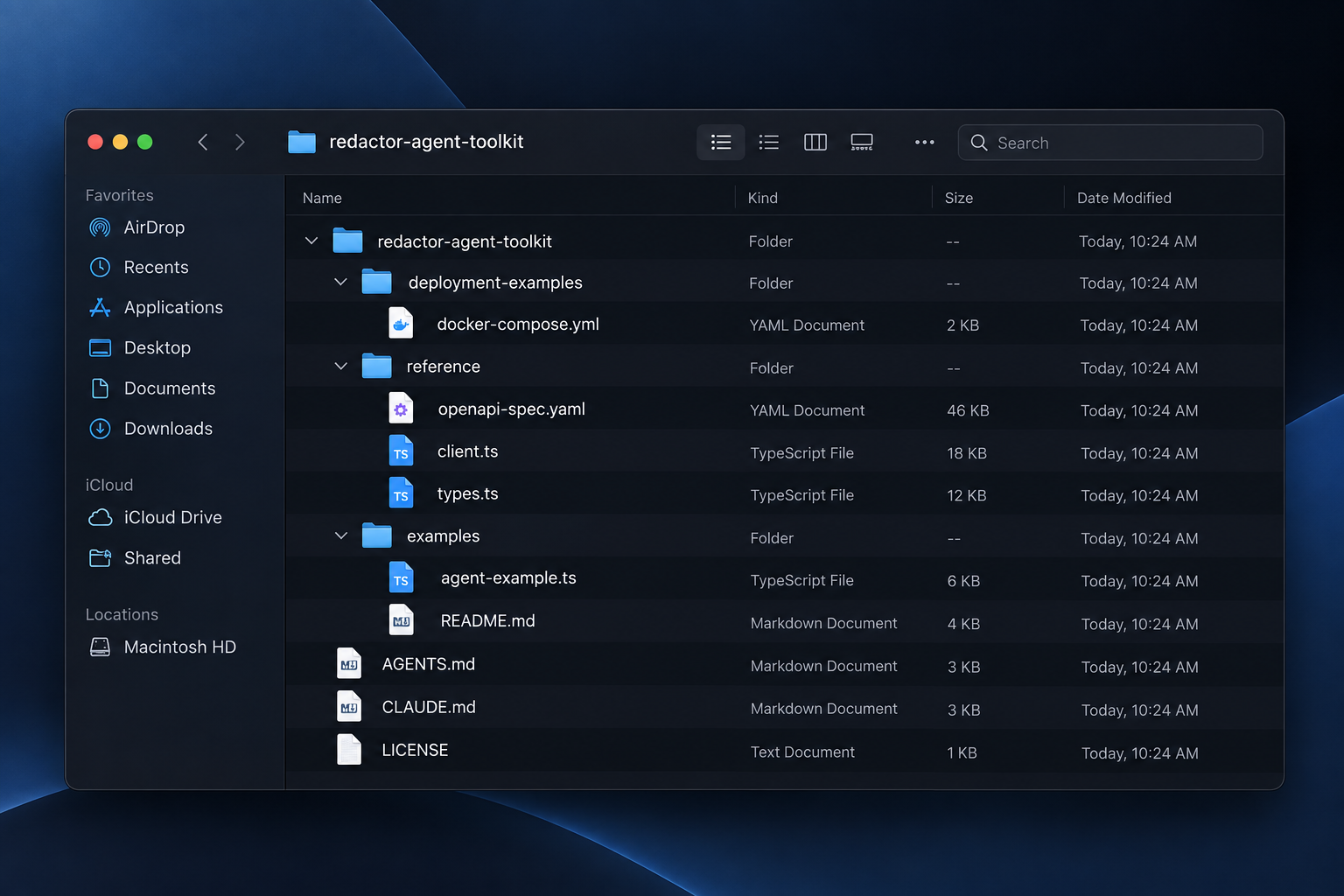
The fastest way to add Redactor to your product.
Integrate Redactor in days, not months.
What used to be a six-month project is now a few days of work for your team and its coding agent. No hand-mapping payloads, no stitching together scattered docs, no first client built from scratch.
from redactor import Client
client = Client(base_url=BASE_URL, token=TOKEN)
job = client.videos.process(
input_path="small.mp4",
operations=["detect_vehicles", "render_output"]
)
print(job.status)
print(job.output_path)Read the API from scratch. Map payloads by hand. Build the first client. Then keep all of it aligned every time the product changed. That was weeks of engineering spent before anything reached a customer.
Read the API from scratch
Before any workflow ran, the team had to learn the surface area manually.
Map payloads by hand
Every request and response shape had to be interpreted and wired up from scattered references.
Build the first client
The setup burden landed before the product team had shipped anything customer-facing.
Re-sync with every change
The first build was only the beginning. Maintenance drag followed it.
Your team starts from working context, not a blank page. The coding agent reads the package, the package reflects the product, and the first workflow gets closer to running sooner.
Everything on this page ladders into four ideas: faster to first result, always in sync, works with your agent, and runs in your environment.
Go from "we should add Redactor" to a running API workflow in days, not months. No weeks lost to setup, no first client to hand-build.
The toolkit is generated from Redactor's own codebase, so it updates with every release. Your team works against the current API, not last quarter's docs.
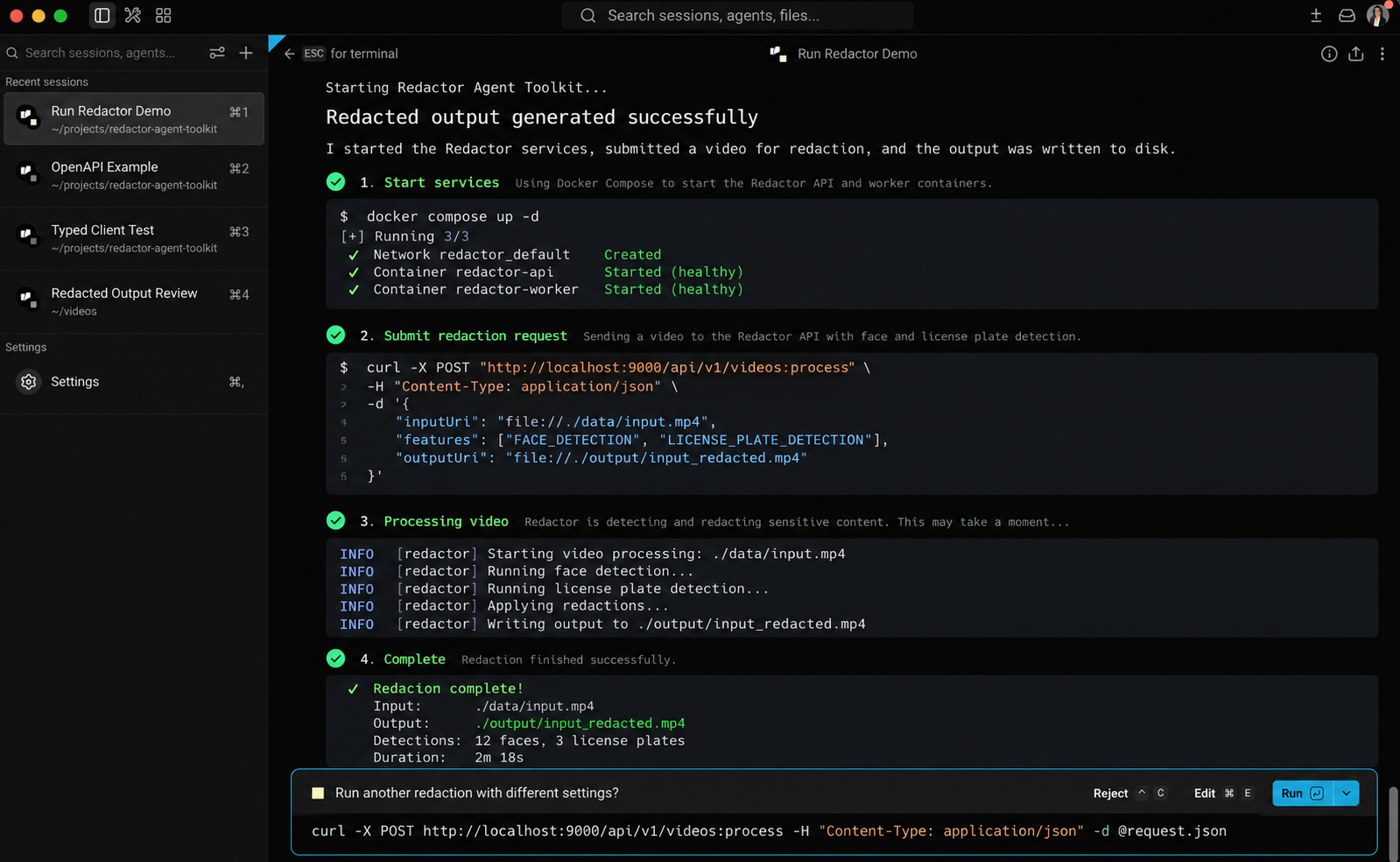
Cursor, Claude, OpenAI Codex, GitHub Copilot, Warp, Windsurf, Gemini. It is not tied to one model or one assistant.
The toolkit works against your licensed Redactor instance in your own Docker setup. Your media and every redaction step stay with you, not in an outside black box.
Each piece earns its place by removing a specific kind of guesswork.
These work together on purpose.
Your agent starts from real context instead of a blank page.
One prompt is enough to pull in a video, redact it, and render the output. Another runs speech detection on a clip. You describe the outcome. The toolkit handles the API calls.
Rebuilding your platform is the worst time to spend an engineering quarter learning a redaction API. Add Redactor as one more thing your agent wires up while your team stays on the rebuild.
This page should work for OEM teams, platform and engineering teams, technical evaluators, and CTOs at the same time.
If your product needs redaction built in, the toolkit is the fast path to first integration, without pulling your team off the roadmap for a quarter.
If you are evaluating Redactor for a broader internal workflow, it cuts the setup burden before deeper architecture work starts.
If you are deciding whether to build redaction or embed it, the toolkit is what makes the time-to-value case clear.
Building redaction is not just the model work. It is the setup, the client code, the maintenance, and the months before anything reaches a customer. The toolkit removes the first layer of setup so your team spends its time on the workflow your product actually needs.
This is the front door. Download if you are ready to work. Read the reference if you need to validate fit. Route licensing questions separately.
Short answers for the questions a technical buyer will ask first. Nothing more.
Do I need to know the Redactor API already?
No. The toolkit gives your team and your agent the structure needed to write the integration code.
What do I need to get started?
A Redactor license, Docker, and the toolkit. Nothing else.
Where does my media go?
Nowhere outside your environment. Processing runs locally against your own Redactor instance.
Does it need an internet connection?
Your media and processing stay local. The one thing that reaches out is licensing. There is an offline license mode if you need to run fully disconnected.
Which languages does it support?
Python is the clearest path today, and the toolkit's type contract generates a working client for it. The same contract feeds a client generator for other languages.
Does this lock me into one AI coding tool?
No. Use whatever coding agent your team already runs.