
By:
Haris RanaLast Updated:
TL;DR
Privacy tools aren’t supposed to feel exciting. They’re supposed to feel invisible, quietly doing the hard work in the background so everyone else can focus on theirs. That’s the standard we hold Redactor to with every release.
Redactor V7 is the biggest step we’ve taken toward that kind of quiet competence. It’s faster, smarter, and most importantly, less noticeable when it’s doing its job.
For agencies and organizations looking for an automated redaction solution that works across video, images, and audio, supports both automatic and manual controls, and allows progressive editing over time, Redactor V7 brings those pieces together in a single, practical system.
What Version 7 Entails
If you’ve been with us for a while, you know that Redactor evolves directly from user feedback. Version 7 grew out of conversations we kept having with investigators, analysts, and compliance officers:
“I spend more time cleaning up frames than finding evidence.”
“Why can’t the system recognize screens or documents like it does faces?”
“Our chain of custody needs to stand up in court, not just in theory.”
The challenge wasn’t just adding more AI. It was reducing the manual friction that slows real cases: mixed lighting, reflections, multi-monitor setups, and environments where a GPU isn’t always available. V7 focuses on practical performance and accountability, not just detection rates.
Over the past year, three themes came up repeatedly:
- Teams now need to redact logos, documents, screens, IDs, and other identifiers, not just people or license plates.
- Agencies must prove who redacted a file, when, and how, not just that it was redacted.
- Editors need progressive workflows that allow work to continue across sessions or shifts without losing context.
Redactor V7 exists because the environment where privacy work happens has changed. Our customers range from local police departments and district attorneys’ offices to enterprises and system integrators, all needing the same guarantee: it just works, every time.
1. Smarter Detection
Let’s start with what you’ll notice first:
Automatic detection of IDs, screens, and documents.
In previous versions, Redactor could already detect, track and redact heads, people, vehicles and license plates. But real videos are rarely that simple. Officers hand over driver’s licenses. Investigators capture handwritten notes. Security teams record workstations and TV screens.
Now V7 handles all of it, automatically.
You can point Redactor at a bodycam clip and it will detect:
- A driver’s license or passport,
- A printed insurance form or document,
- A laptop or phone screen in the background,
- Faces and vehicle registration documents.
All tracked and blurred automatically, even as lighting or angles shift.
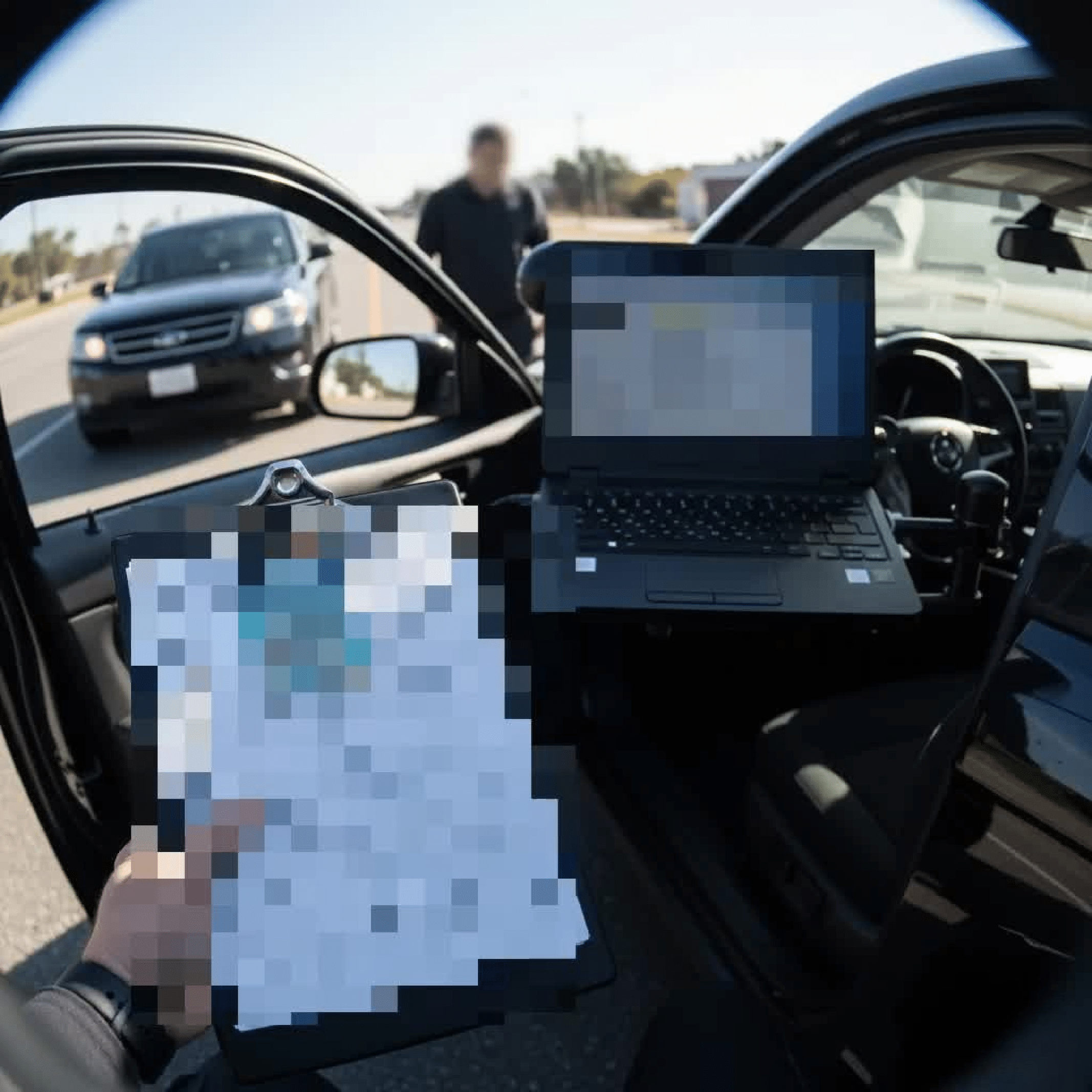
If reflections or multiple monitors appear, you can adjust the detection confidence threshold to catch more or fewer potential matches.
It’s automation that feels controlled.
(And yes, Brent, our VP Engineering at Redactor, really did test it on three monitors under bad lighting, because engineers are nothing if not stubborn.)
2. Inverse and Zone-Based Redaction
Sometimes the question isn’t what to hide, it’s what to keep.
Redactor V7 introduces inverse, or zone-based, redaction. Instead of selecting everything that must be blurred, reviewers can preserve specific subjects while masking the surrounding environment by default.
This is especially useful for law enforcement and GDPR-sensitive reviews, where bystanders, interiors, or entire crowds must be obscured while a subject of interest remains visible.
The workflow supports progressive editing. Analysts can start a review, pause, and return later, or hand it off to another reviewer, without losing state or traceability.
3. Audit Logs
In earlier versions, redaction effectively ended when the blur was applied. V7 extends accountability beyond that point.
Redactor V7 introduces per-session audit logs that record:
- Who accessed a file
- When automatic detection or manual edits occurred
- Which objects were created, modified, or removed
- When exports happened and under whose credentials
Each file is cryptographically hashed on import and export, allowing teams to independently verify file integrity.
For organizations that require structured oversight, Redactor also supports role-based access control, enabling administrators to define permissions by user, case, or department.
Redactor now answers the question auditors and courts always ask: can you prove this was handled correctly?
4. Audio Redaction with Transcription
Video isn’t the only source of sensitive information. Interview rooms, patrol recordings, and 911 audio often carry just as much risk.
Redactor V7 strengthens audio-only workflows with improved speech transcription in multiple languages that stays synced to the timeline. Reviewers can search for names, addresses, or case numbers, jump directly to those moments, and redact audio using mute, beep, or scramble effects.
Audio and video now live in the same review environment, following the same principles and controls, instead of being split across tools.
5. Performance and Workflow
Every new version brings stronger AI, but not everyone has the same hardware, or internet access.
That’s why Redactor V7 adds a smarter GPU fallback system. If a machine doesn’t have a supported GPU, it automatically switches to CPU processing without breaking workflow.
You can still:
- Upload and redact videos, images, or audio files.
- Export final outputs in standard formats such as MP4.
- Run fully offline in secure environments where internet connectivity is restricted.
We’ve also made the editing process faster with:
- Bulk selection and invert tools,
- Timeline grouping to cluster related objects,
- Keyboard shortcuts for high-speed review.
For cloud users, Redactor remains compatible with popular DEMS environments, allowing teams to group case assets such as photos, CCTV clips, and interviews into organized folders for redaction and export.
Why This Matters
Every automation in V7 is designed to give human reviewers more room for judgment, not less. Redaction at scale is a concentration problem. People get tired, miss frames, or rush exports.
The new or expanded detection catches more edge cases. Audit logs make decisions defensible. Audio transcription bridges video and audio workflows that used to live in separate tools.
When technology works in the background, users can focus on the story their footage tells, not the software they’re using to protect it.
A Quick Note from the Engineering Floor
During early testing, our engineers spent days looping the same five-second clip of a laptop reflection in low light. They refused to ship until the detector stopped blinking between frames. (Coffee consumption was equally persistent.) That’s the difference between software that demos well and software teams can rely on.
Looking Ahead
Every year, public agencies capture more footage than they can review. With that scale comes a greater duty to protect personal information.
Redactor V7 is one more step toward that goal: an automated video redaction solution built for real teams.
Our mission stays the same: to make privacy practical.
Where we go next depends on what you need us to simplify next.

Watch Redactor V7 in action, or Try Sighthound Redactor today.
For business opportunities; explore our Partner Program.
Published on: