
By:
Ali AhadLast Updated:
TL;DR
Parents requesting school footage triggers FOIA/state law + FERPA rules. Schools must narrow scope, redact other students’ PII (video + audio), QA carefully, and document everything to release footage safely and defensibly.
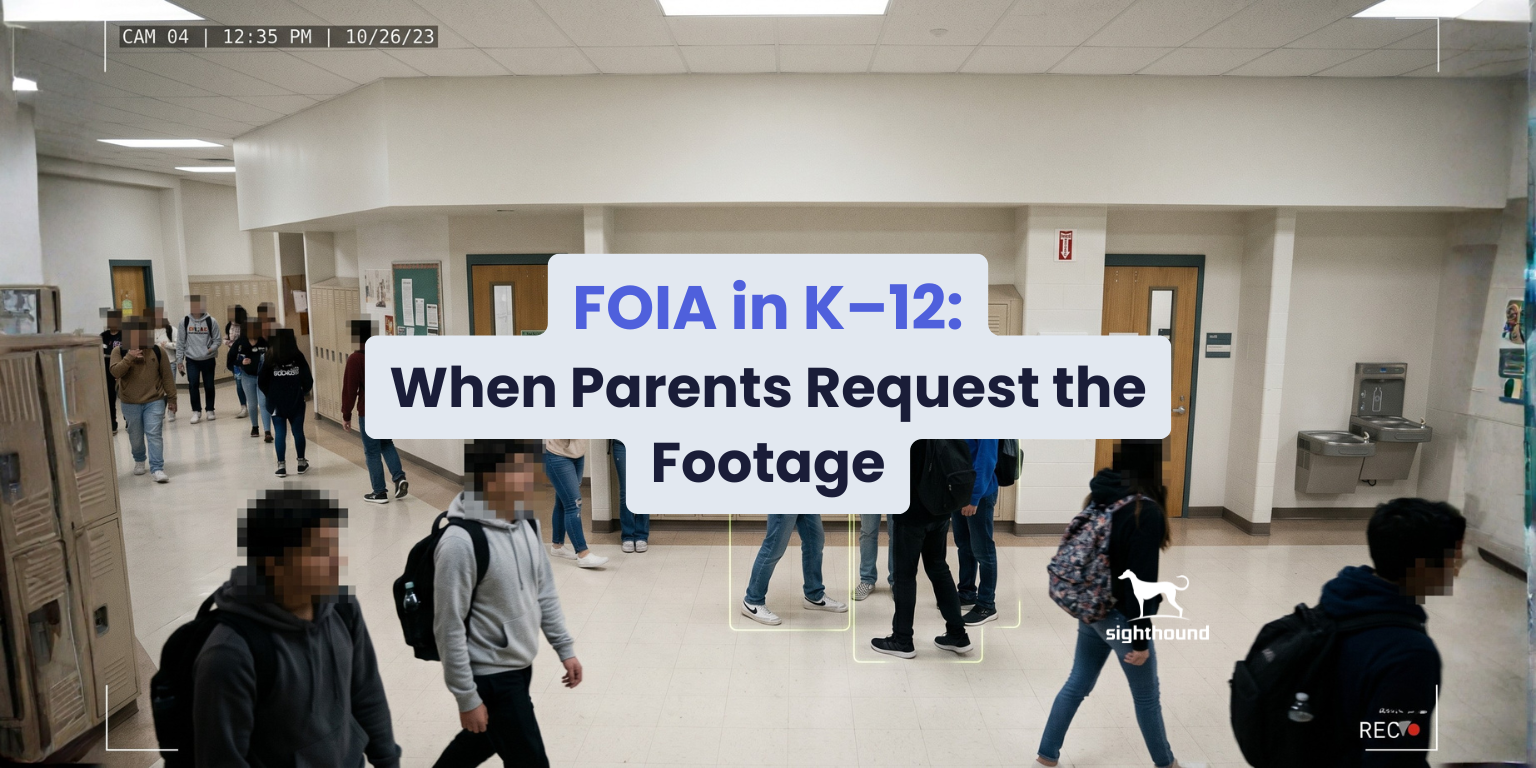
A parent’s school surveillance video request usually follows a serious incident, a bus altercation, a hallway injury, a bullying report, or a disciplinary dispute. These requests move quickly, involve strong emotions, and create legal risk if districts respond without a clear process.
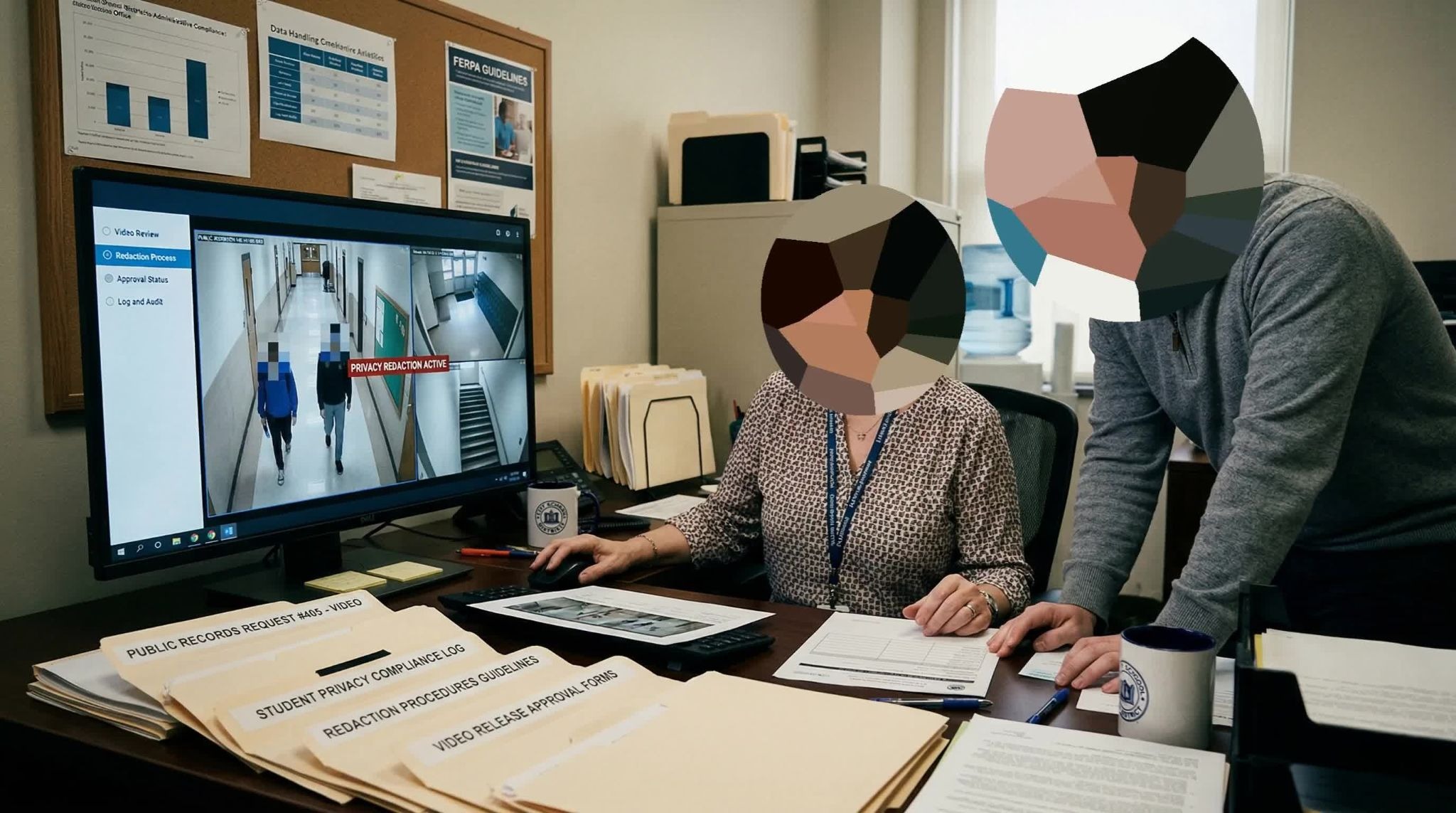
The challenge is balancing transparency with student privacy. State public records law may require disclosure, while FERPA can limit what can be shown. Most clips also include uninvolved students, which means schools often must review, narrow, and redact footage before release.
This guide explains how K–12 teams can handle requests in a way that is lawful, consistent, and practical.
Why Every School Surveillance Video Request Needs a Standard Workflow
Districts rarely receive these requests under ideal conditions. Families want fast answers, school leaders want resolution, and media attention can increase pressure. Without a standard workflow, schools risk:
- over-disclosure that exposes other students,
- inconsistent responses across campuses,
- delayed responses that escalate conflict,
- weak documentation if a decision is challenged.
A repeatable process improves speed and defensibility at the same time.
Is a School Surveillance Video Request Covered by FOIA or State Law?
Families often say “FOIA,” but the federal FOIA applies to federal agencies. Public school districts are typically governed by state open records/public records laws, each with its own deadlines, exemptions, fee rules, and appeal process.
Authoritative reference: FOIA.gov FAQ (federal scope)
Is school camera footage a public record?
In many states, surveillance footage can qualify as a public record if it is created or maintained in the ordinary course of district operations. But “public record” does not mean automatic full release.
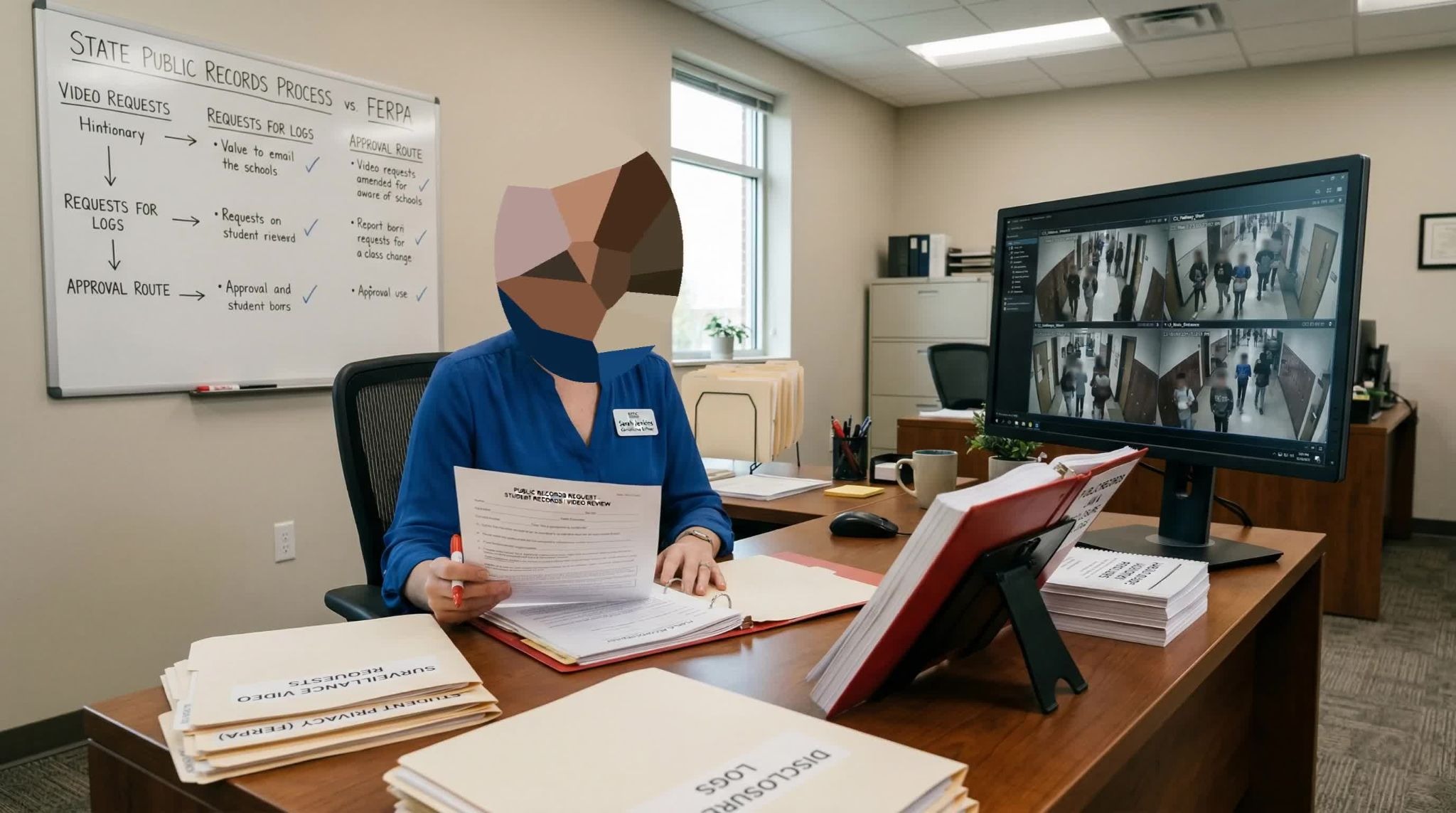
Schools still need to evaluate scope, exemptions, and privacy constraints.
Key screening questions:
- Does the footage still exist, or was it overwritten?
- Is the requested time window specific enough to locate?
- Are unrelated students visible or audible?
- Does the clip overlap with an active investigation or safety response?
In practice, many requests result in partial disclosure rather than the release of raw footage.
FERPA Rules for School Video Requests
When surveillance footage may be an educational record
FERPA applies to records directly related to a student and maintained by the school or district. Depending on how footage is used and stored, a clip may fall under FERPA review, especially when used for disciplinary or grievance processes.
Parent access rights vs. other students’ privacy rights
Parents may have rights related to records about their child, but districts must still protect personally identifiable information (PII) for other students in the same footage.
Common complaint options include:
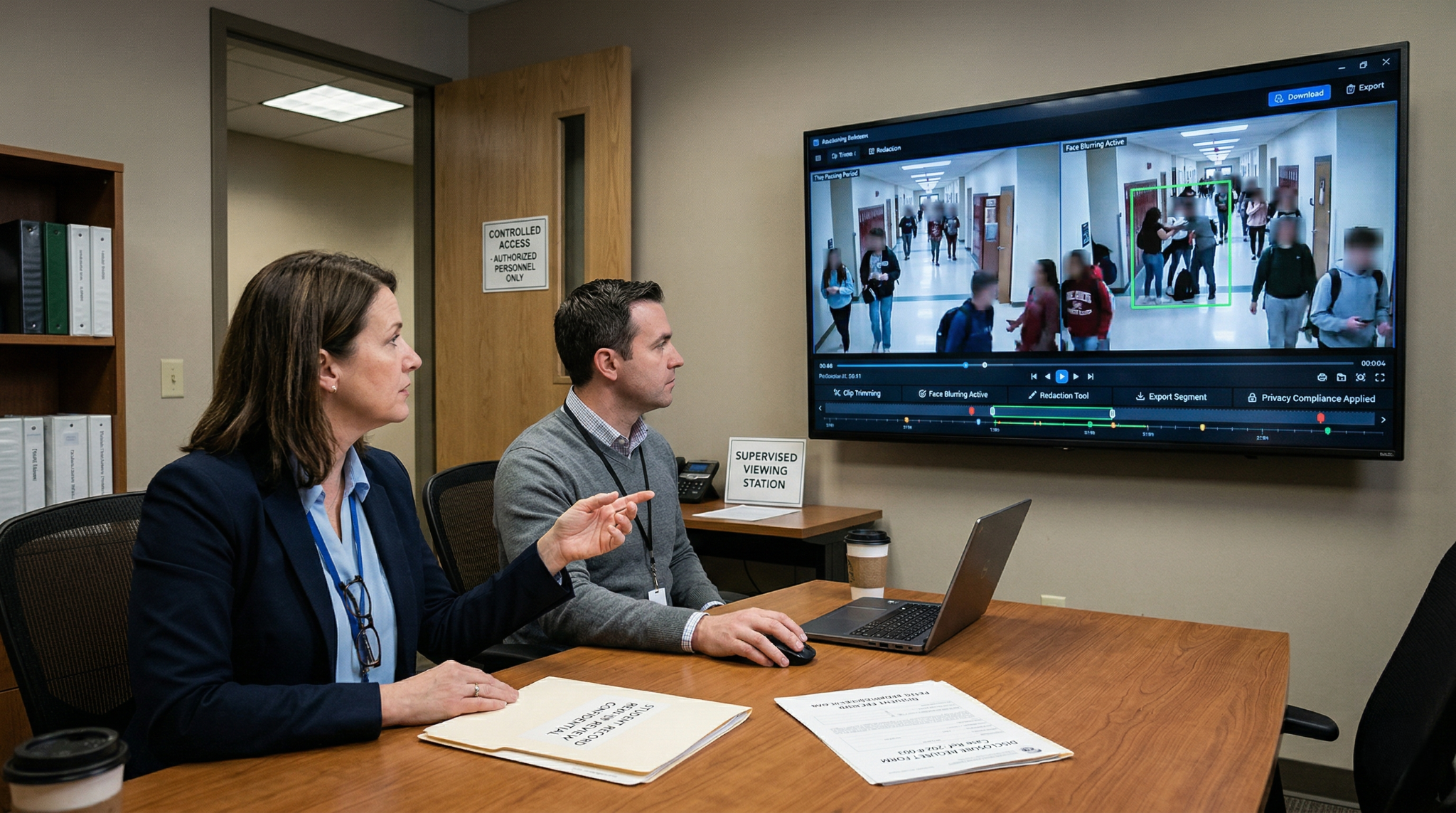
- supervised in-person viewing,
- release of a redacted copy,
- narrowed clips focused only on the incident window,
- or another method allowed under state law and district policy.
PII in video includes more than faces
Identity cues can include name labels, uniforms, student IDs, voice references, seating patterns, and timestamp/location context. An effective review must cover both video and audio.
Why Redaction Is Central to a Compliant School Surveillance Video Request
Redaction is what makes lawful disclosure possible when footage contains protected student information.
Protecting uninvolved students in shared spaces
Incidents often happen in high-traffic areas like hallways, cafeterias, buses, gyms, and playgrounds. Even short clips can include many uninvolved minors.
Removing direct and indirect identifiers
Face masking alone is often insufficient. Schools may also need to obscure names on clothing, laptop screens, ID badges, or posted rosters.
Excluding unrelated sensitive moments
Requested footage may capture unrelated medical care, behavioral incidents, or private conversations. Those moments should not be disclosed simply because they are in the same time range.
Operational Challenges Districts Face
Manual editing is time-intensive
Frame-by-frame review is often required in crowded or fast-moving scenes. Small teams can struggle to meet legal timelines when requests involve multiple cameras or long windows.
Quality control failures create exposure
A single unredacted frame can reveal a student. Districts need a second-pass review before release, especially for complex scenes.
Evidence handling must stay clean
Original footage should remain untouched. Redaction should happen on derivative copies with version control and access logs to preserve evidentiary integrity.
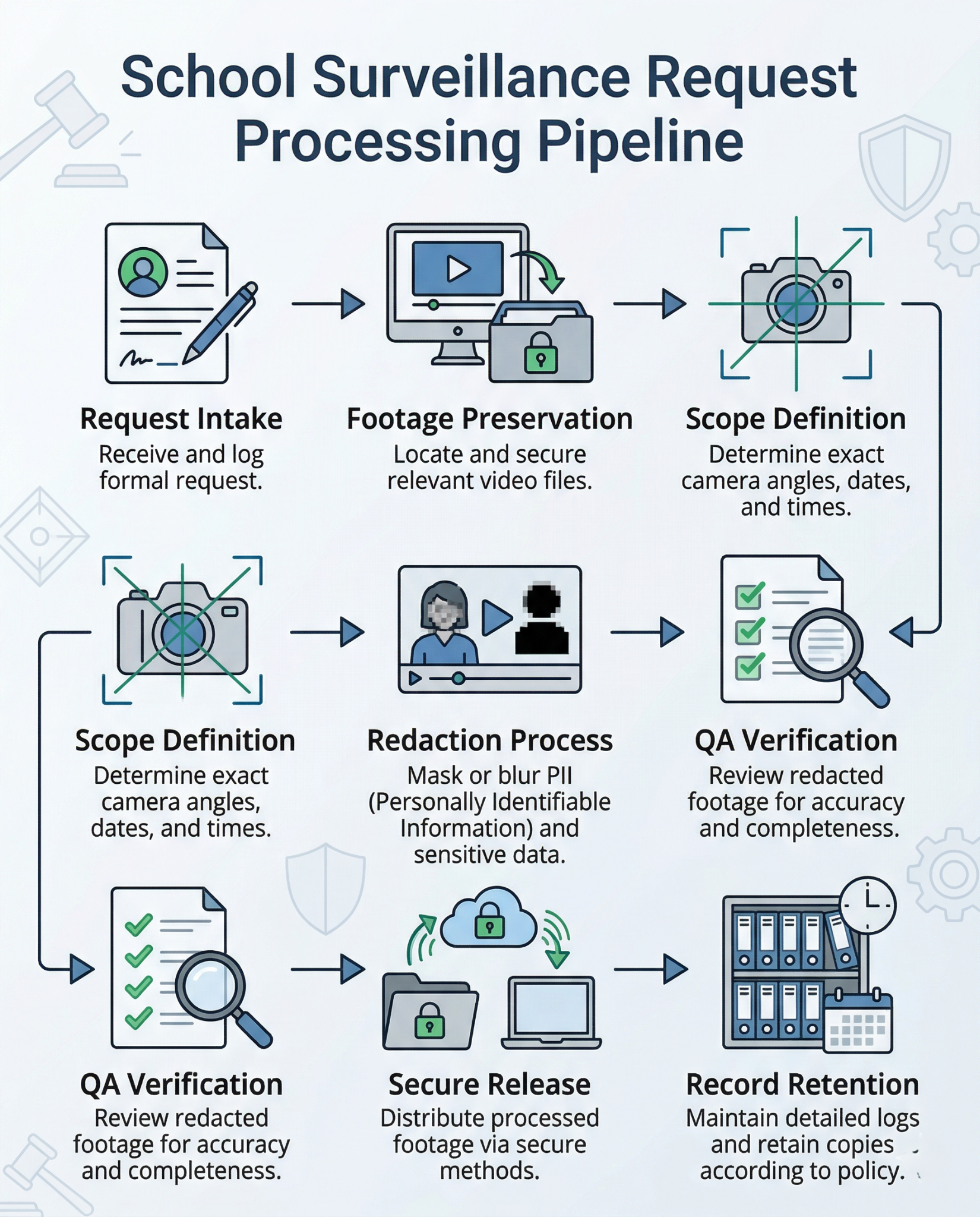
Recommended Workflow for Handling a School Surveillance Video Request
- Intake and classify the request
Capture requester type, incident scope, legal basis, and response deadline.
- Locate and preserve originals
Secure source footage immediately to avoid overwrite loss.
- Define responsive scope
Narrow by camera angle and timeframe where legally permitted.
- Redact protected content on derivative copies
Mask uninvolved students, identifiers, and unrelated sensitive details.
- Run secondary QA review
Verify mask continuity, audio treatment, and export accuracy.
- Release through controlled channels
Send only approved versions and document date/method of disclosure.
- Retain records and audit trail
Keep originals, redacted outputs, and logs under policy/legal retention rules.
Educational Note on Tooling
Policy and counsel determine what may be released. Software helps teams execute those decisions more consistently. For example, districts may use dedicated redaction platforms such as Sighthound Redactor to support face/object tracking, review workflows, and audit logging in higher-volume environments.
How Sighthound Redactor Builds a Defensible, Parent-Responsive Process
Schools should treat each school surveillance video request as a governed compliance workflow, not a one-off administrative task. The strongest programs combine clear intake rules, timely preservation, careful redaction, second-pass QA, and complete documentation.
Key Features & Benefits
- Fully automated video & image Redaction – Redactor automatically blurs heads, vehicles, and license plates, protecting student privacy while keeping footage usable for security teams.
- On-Device AI Processing – All video is processed locally, avoiding cloud uploads and reducing data breach risks, ideal for compliance with GDPR, FERPA, CCPA, and COPPA.
- Easy Integration – Works with most existing camera systems, with a robust API and customizable presets, making deployment quick, affordable, and disruption-free.
- Edge & Cloud Deployment – Run redaction on-premises for security-critical environments for maximum security.
That approach helps districts deliver meaningful transparency to families while protecting uninvolved students and reducing legal risk.
Want to learn more about AI-powered redaction & digital content compliance?Try Sighthound Redactor today.
Want more insights? Read our AI-powered redaction best practices.Need a live demo? Schedule a Redactor demo now.
Published on: