.png)

By:
Ali AhadLast Updated:
TL;DR
Choosing redaction software requires evaluating detection accuracy, workflow control, deployment flexibility, and compliance alignment with frameworks like FOIA, CJIS, HIPAA, and GDPR. Sighthound Redactor detects, tracks, and redacts heads, people, license plates, vehicles, IDs, screens, and documents across video, image, and audio, with options to blur visuals and mute or scramble sound. It supports law enforcement, legal teams, and enterprises that need reliable, scalable redaction without exposing sensitive data.
If you are comparing redaction software, you are probably trying to solve two problems at once, move faster through growing media backlogs and reduce the risk of a privacy mistake that becomes a legal or reputational issue.
That is exactly where most teams get stuck. Vendor demos make many tools look similar, especially when every product claims automation, AI detection, and fast exports. But real-world outcomes depend less on feature lists and more on how a platform performs under your actual workload: noisy bodycam footage, mixed media formats, tight disclosure timelines, and cross-team approvals.
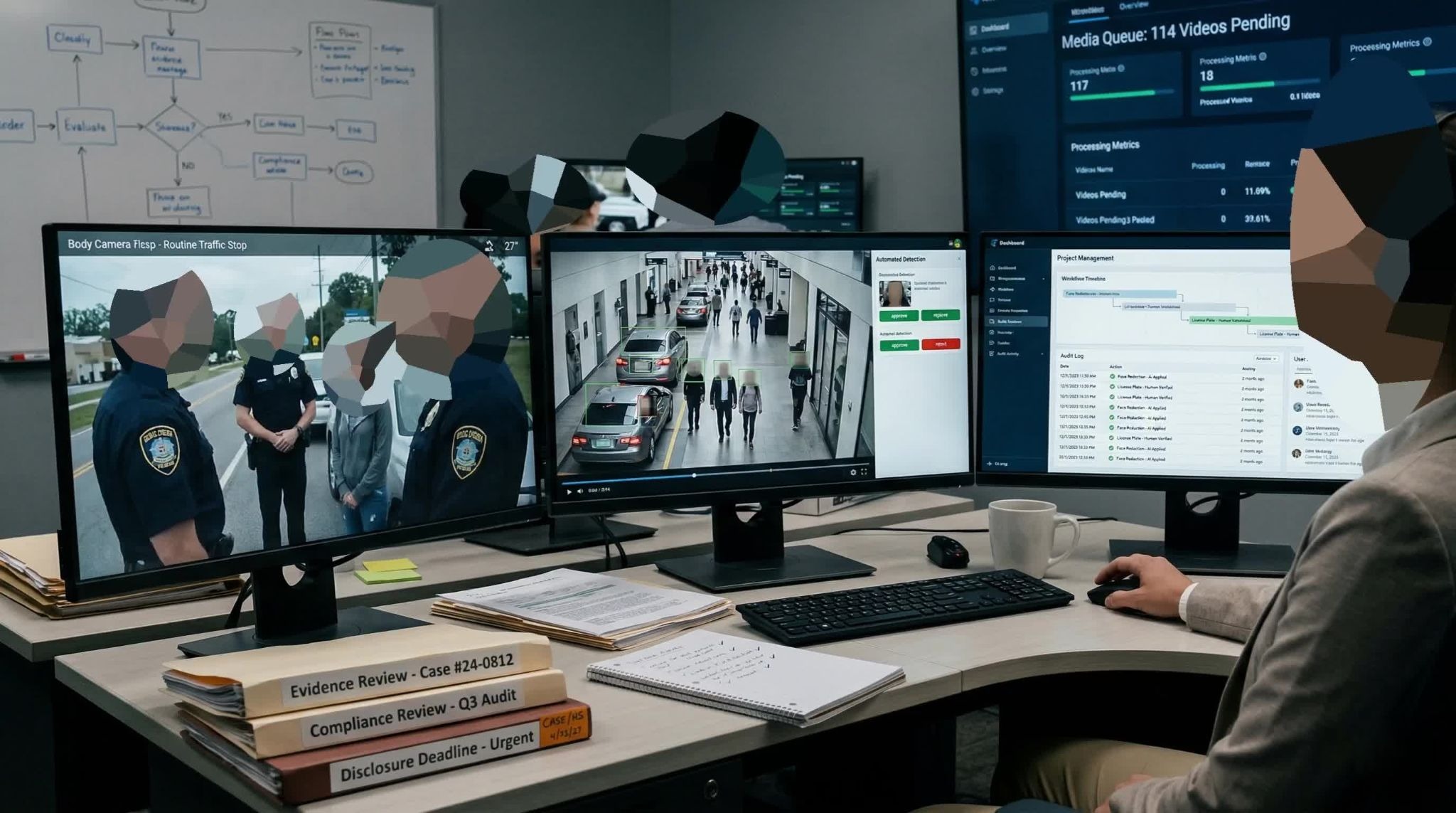
This guide is built for public records teams, law enforcement, legal departments, healthcare organizations, and compliance teams evaluating video redaction software for operational use. Instead of comparing marketing language, use these five questions to evaluate what matters most:
- Can you speed up work with automated redaction while keeping human control?
- Do AI redaction tools perform accurately on your media conditions?
- Can the platform sustain reliable video-evidence redaction under motion and occlusion?
- Will the audit records support defensible privacy-compliance redaction decisions?
- Can the system scale across volume, teams, and deadlines?
Whenever you are evaluating automated video redaction solutions, these questions give stakeholders a shared framework for selecting redaction software that is both efficient and defensible.
1) How much automated redaction can you use without losing human oversight?
Automation is useful only when it reduces repetitive work without weakening governance. In practice, that means separating three layers of capability:
- Detection automation (finding faces, plates, ID’s, and other sensitive elements)
- Editing automation (tracking and maintaining masks over time)
- Workflow automation (routing files, assigning reviewers, and recording approvals)
Many teams over-index on detection and miss the workflow layer. A tool may detect objects well but still force analysts into manual status tracking, ad hoc handoffs, and inconsistent approvals. That creates bottlenecks even when model quality is strong.
Strong automated redaction should make the analyst faster, not less accountable. You want explicit human checkpoints for high-risk disclosures, plus role-based permissions that prevent unauthorized exports.
What to test during pilots
- Manual touches per file from intake to release
- Time spent on handoffs versus actual review
- Ability to batch similar edits across multiple files
- Role-based approval controls for final output
- Rework rates after QA review
Decision signal
If automation reduces cycle time but increases QA rework or approval confusion, the workflow design is not mature enough. The right redaction software improves speed and control at the same time.
2) How accurate is your video redaction software on real-world footage?
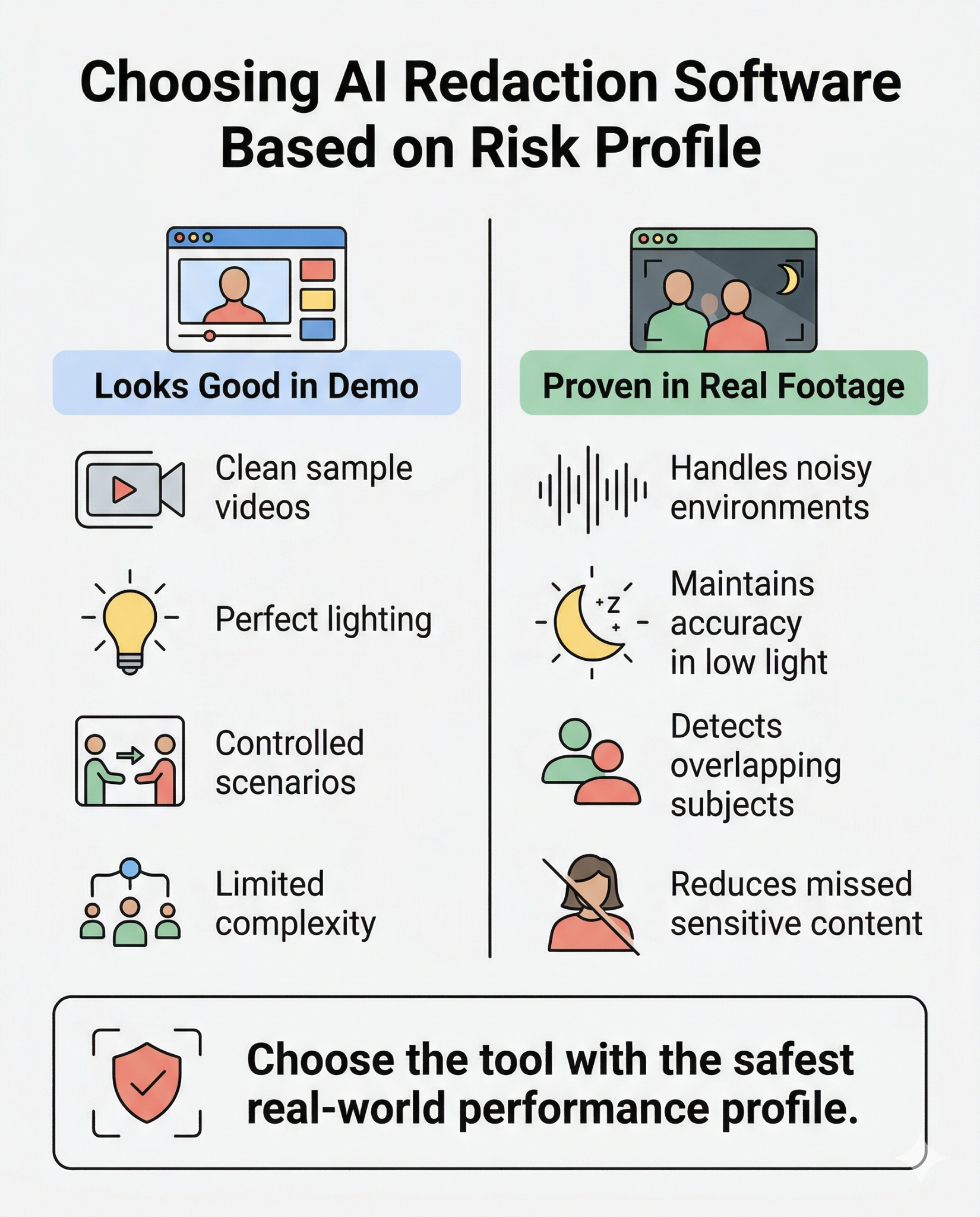
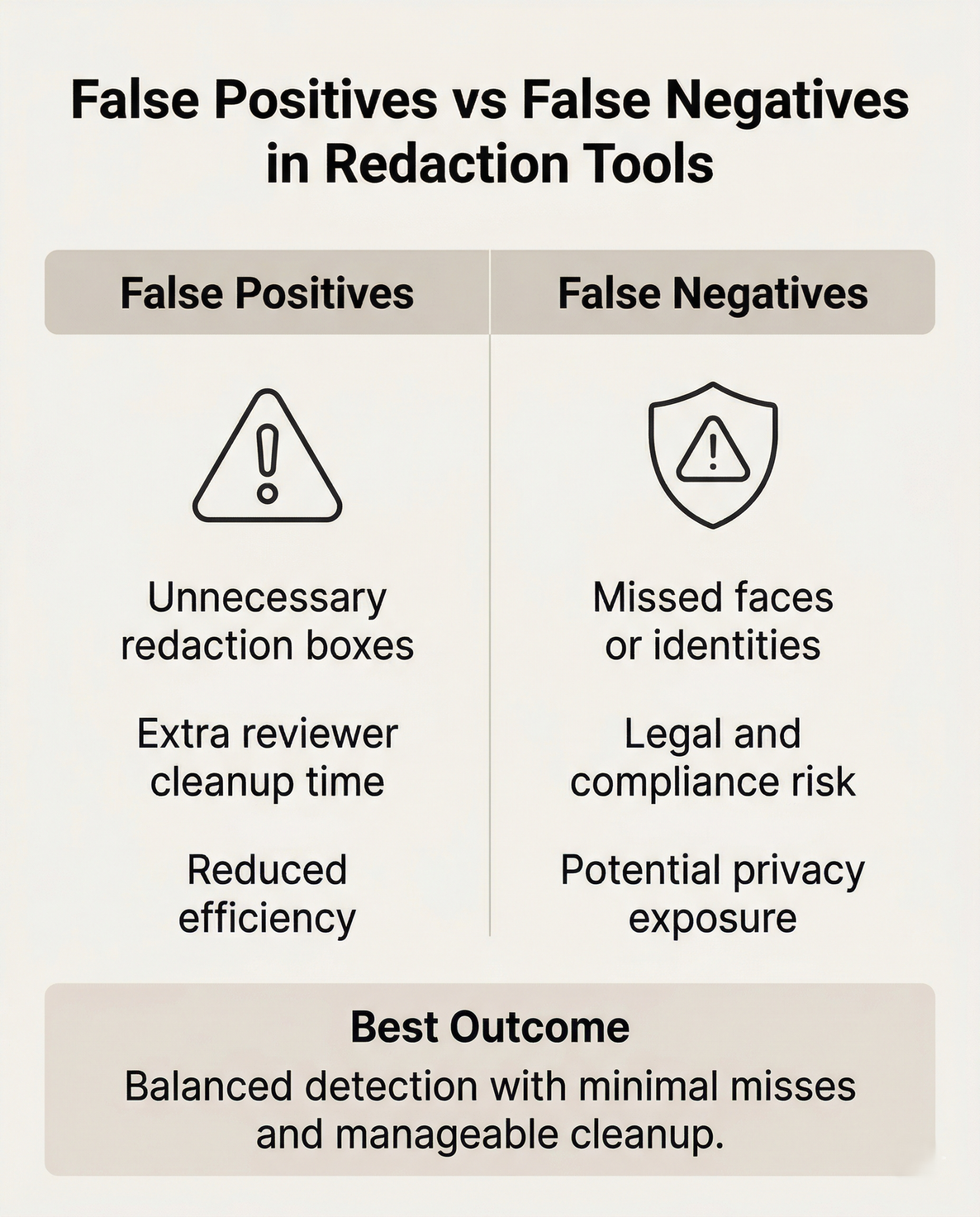
This is the make-or-break question for AI redaction tools. False negatives can expose sensitive information. False positives can overwhelm reviewers and erase efficiency gains. You need both metrics, not one.
Do not rely on curated samples. Build a representative evaluation set that mirrors your evidence reality:
- Day and night clips
- Motion-heavy bodycam footage
- Compression artifacts from older systems
- Crowded scenes and overlapping subjects
- Audio with background noise and interruptions
When teams evaluate video redaction software, they often discover that top-performing demo tools diverge quickly on low-light or unstable footage. That gap directly affects disclosure safety and staffing load.
How to score detection quality
- Track precision and recall per media condition
- Report misses by risk severity (not just total count)
- Measure cleanup time for false positives
- Compare first-pass completion rates across vendors
- Re-test after model or configuration updates
Decision signal
Choose the platform with the best risk-adjusted profile, not the prettiest demo. A tool with slightly higher reviewer cleanup may still be safer if it materially reduces missed PII-sensitive content.
3) Can the platform keep video evidence redaction consistent across every frame?
A common failure in video evidence redaction is continuity, not initial detection. A mask appears in one frame, drops during motion or occlusion, then reappears. That one-frame exposure can still create a compliance incident.
Reliable tracking is critical when footage includes:
- Rapid camera movement
- Temporary subject occlusion
- Scene crowding and intersecting paths
- Zoom shifts and re-entry after off-screen movement
If tracking breaks frequently, analysts return to frame-by-frame correction. Throughput drops, fatigue rises, and error risk increases.
Continuity checks to include in a pilot
- Frame continuity errors per minute and per file
- Time to recover when a tracker loses lock
- Mask persistence after timeline edits and trims
- Export integrity checks to confirm no dropped masks
- Multi-subject tracking under dense movement
Decision signal
For high-stakes disclosure workflows, continuity performance often matters more than first-frame detection speed. The best redaction software keeps protections stable throughout the clip, even when the footage is messy.
4) Does it produce privacy compliance redaction records you can defend?
A visually correct output is only part of defensible redaction. You also need to process evidence that shows who did what, when, and under which policy.
For privacy compliance redaction, your system should capture:
- User-level action history
- Version lineage from the source to the released derivative
- Reviewer and approver identity with timestamps
- Policy-aligned reasons for key decisions
- Exportable records for legal or audit response
This matters in FOIA challenges, litigation support, internal investigations, and regulatory review. If an output is questioned months later, your team should be able to reconstruct the complete decision trail without guesswork.

Audit-readiness checks
- Can logs be exported quickly in a review-friendly format?
- Do records tie actions to exact file versions?
- Are retention and access controls policy-aligned?
- Can you prove the separation of duties across roles?
- Can legal teams retrieve six-month-old records fast?
Decision signal
If logs are shallow, hard to export, or disconnected from version history, treat that as a material risk. Redaction software should support legal defensibility, not just visual editing.
5) Will the redaction software scale across volume, teams, and deadlines?
A platform can look excellent in a small pilot and still fail in production when the
data request volume spikes. Scalability is operational, not just computational.
Test whether the system supports:
- High-volume batch intake and processing
- Queue visibility for managers and reviewers
- Clean workload distribution across analysts
- Cross-team collaboration without policy drift
- Consistent controls across video, audio, and still images
This is especially important when teams handle mixed disclosure workloads at once. Fragmented toolchains can create inconsistent outputs, duplicated effort, and higher training overhead.
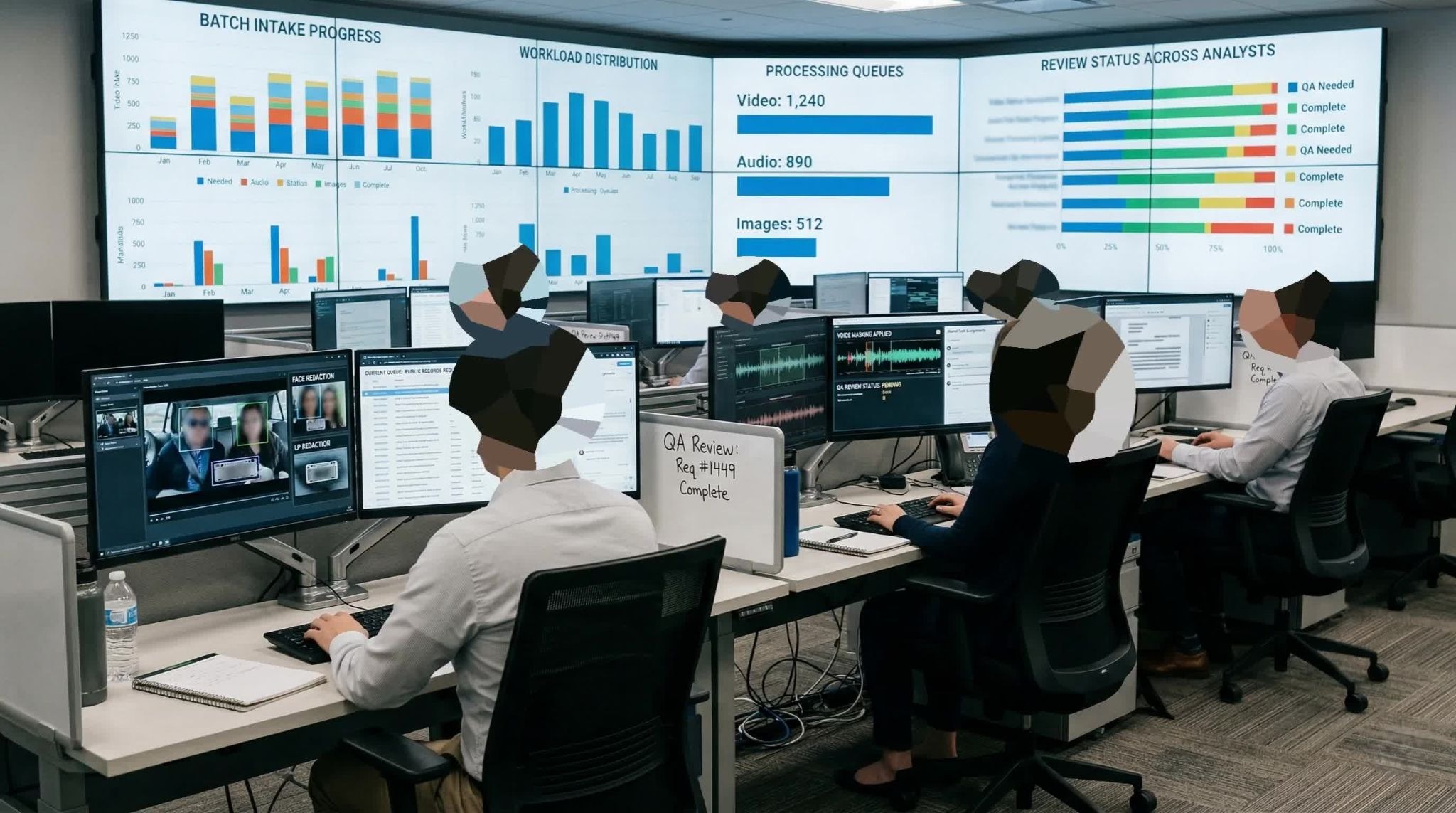
If your environment includes bodycam, interview audio, and surveillance footage, unified processing matters. A single workflow for video evidence redaction and related media is usually easier to govern than separate specialized tools.
Scale validation metrics
- Files processed per analyst per day
- Turnaround time at normal and peak load
- Backlog growth rate under demand spikes
- QA pass rates by team and media type
- Rework and escalation rates over time
Decision signal
The right redaction software stays predictable under pressure. It should help teams meet statutory timelines without trading away accuracy or compliance controls.
Evaluate for Robustness
Choosing redaction software is a risk-management decision as much as a productivity decision. The strongest evaluations focus on five outcomes: trustworthy automation, real-world detection accuracy, frame-level continuity, defensible audit records, and reliable scaling under load.
Run your pilot with representative media, stress scenarios, and measurable pass/fail criteria. Then compare Sighthound Redactor and other vendors against the same scorecard. That keeps the process objective and helps legal, compliance, and operations teams align on a platform they can trust in production.
Those who choose AI redaction will secure efficiency, compliance, and public trust.
Want to learn more about AI-powered redaction & digital evidence compliance? Try Sighthound Redactor today.
Want more insights? Read our AI-powered redaction best practices.Need a live demo? Schedule a Redactor demo now.
Published on: